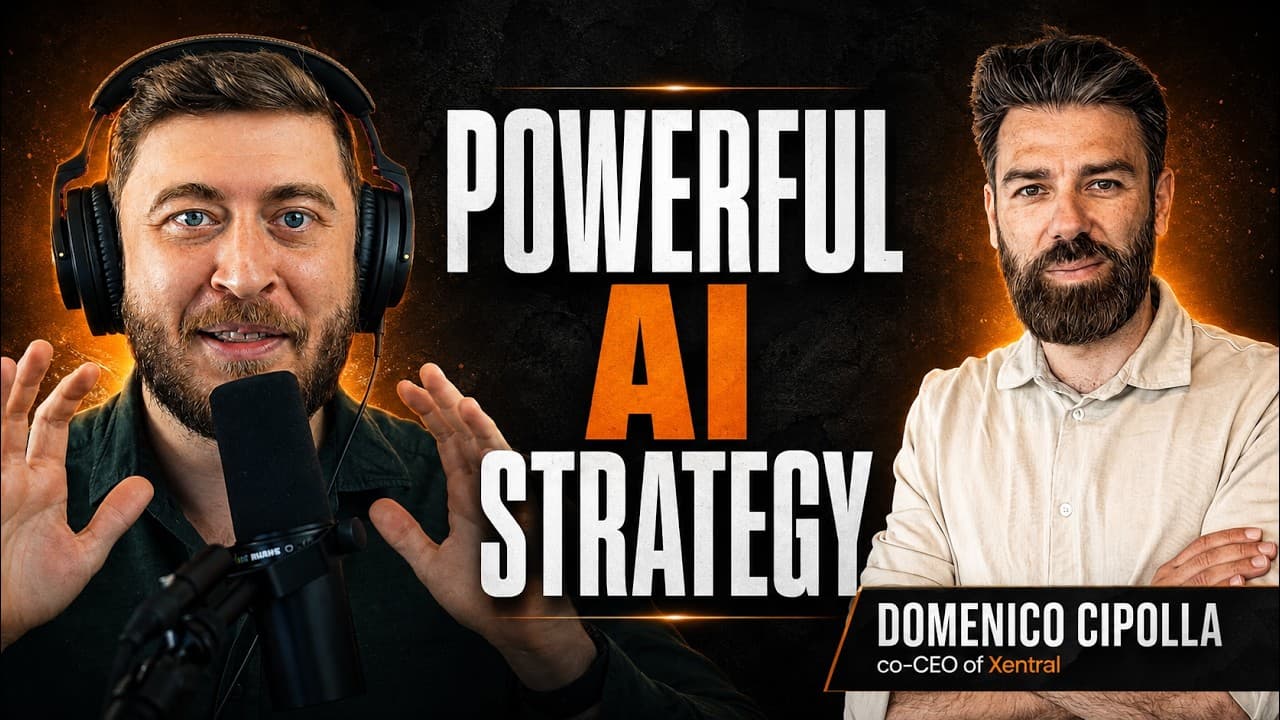
From Classrooms to AI Tutors: The Next Revolution | Edan Shahar | Wild Zebra
with Edan Shahar — CEO & Founder, Wild Zebra
Hosted by Shamil Malachiyev · The Founder's Code
About Edan Shahar
CEO & Founder · Wild Zebra
Edan Shahar is CEO and founder of Wild Zebra, an education startup using AI to give every student a personalized learning partner. It's live with 6,000 students across four top US independent schools, focused on math and reading for grades three through 10. Edan has been building companies since 2006, from an early social network to an advertising venture, and once ran Israel's quantum computing center.
Originally from Israel and based in the US, he's a serial founder who works with non-technical co-founders and near-founders. He talks openly about why teachers stay in the loop, why he chooses urgency over patience, and why, if money were no object, he'd still be building Wild Zebra.
Summary
Edan Shahar is building Wild Zebra, an AI learning partner already used by 6,000 students. He explains his vision of a tutor that stays with you for life, why teachers stay in the loop, why building gets easier to succeed but never easier emotionally, and why he chooses urgency over patience.
Key takeaways
- 01Wild Zebra's vision: an AI educational partner that starts in middle school and stays with you for life.
- 02The last human job, Edan argues, is teaching other humans how to be better humans.
- 03Education tools have to break AI's habit of giving answers — the goal is the student discovering them.
- 04Building gets easier to make successful, but the decisions stay just as hard.
- 05Edan chooses urgency over patience on purpose, and saves the patience for his kids.
- 06If money were no object, both founders would keep building anyway.
Keywords
Show notes & transcript
What is Wild Zebra's vision for AI in education?
Wild Zebra is building an AI educational partner that starts in middle school and stays with you for life, Edan Shahar says. His five-to-six-year vision is an agent that knows how you learn best, the time of day, the right amount of encouragement, and how to contextualize a concept so you understand it. It contextualizes everything, so instead of a generic train leaving Chicago, a student learns the math through whatever they're actually interested in. One student told the team they'd learned all of math through a niche personal interest almost nobody knows about. Today the company is hyper-targeted on math and reading for grades three through 10, working with four top independent US schools and 6,000 students. The tool also loops in teachers, flagging where students advance or get stuck. AI is good at meeting students where they are, and that engagement, he argues, is most of the battle.
"Why not have your education be in the context of the things you're interested in?" — Edan Shahar, CEO, Wild Zebra
Will teachers still be needed once AI can tutor?
Teachers stay in the loop all the time, Edan says, because AI can teach knowledge and skills but not character. His deeper claim: the very last job any human will have is teaching other humans how to be better humans, because AI will never have had the experience of being human. His own ability to hold a conversation was honed over 38 years of talking to people and working in groups, and much of the best learning is physical, tactile and social, not in front of a screen. He also draws a design line most AI tools cross: they want to give answers, and Wild Zebra has to break that, because in education the goal is to facilitate the student discovering the answer, not to hand it over. Under the hood that means a tool that truly understands where a student's gaps are, a Socratic tutor, and a supportive coach who knows when to encourage.
"The very last job any human will have is teaching other humans how to be better humans." — Edan Shahar, CEO, Wild Zebra
Does building a company get easier the second or third time?
Building a company gets easier to make successful, but not emotionally easier, Edan says. The hard-won lessons from each previous company pay dividends: focus, sales cycles, distribution. From his first startup, a social network built as Facebook was scaling, he learned to fight feature creep and ask constantly what's truly critical versus nice to have, a maniacal focus that seems obvious but plays out as a real fight on the ground between designers, developers and salespeople all pulling in different directions. From a later advertising and charity company, he learned how the sales cycle at large companies can kill you, and why a pain-reliever story compresses that cycle where a vitamin story doesn't. He's more likely to succeed now because of those learnings, but the decisions are just as hard. The biggest difference this time isn't the work; it's being at a different life stage, with two young kids.
How do you balance urgency and patience as a founder?
Edan actively chooses urgency over patience, and knows it costs him. Patience isn't something he wants to optimize right now, he says; building internal pressure is helpful, so he tries not to have too much patience at work, saving it for his kids. Shamil pushes back with his own lesson: allowing yourself to be patient means allowing yourself to be more aggressive, because a task quoted at three weeks can often be done in a week if you push, which is what separates the Elon Musks. Edan agrees there's truth to it, but adds a caveat: it's about knowing your team deeply, because if you're always pushing, the team learns to pad estimates, and you reach a stasis point. The interplay between urgency and patience is something he hasn't mastered, and he half-jokes he'll report back once he's 45 or 50.
What would Edan Shahar do if money were no object?
If money didn't exist, Edan would be doing exactly what he's doing: building Wild Zebra. He'd take it even further, he says, if he'd raised a hundred million without investors breathing down his neck, so he could walk more paths simultaneously. For him the work isn't work; real work would be a coal mine or a front line. Both founders land in the same place: they're wired to build, and a purely consumptive state feels taxing, not relaxing. Shamil describes watching Court Lorenzini, in his sixties, start a new company and fire off 3am emails full of energy, and thinking, that's who I want to be at 60. Edan's version of retirement is retiring into his hobby every day, or maybe a year of silent meditation in a cave. His own drive is regret minimization: he can't let his 37-year-old self down by not giving this a go.
"It's more important than building a good work ethic to find something you like doing so much that it doesn't feel like work." — Edan Shahar, CEO, Wild Zebra
Transcript
ShowHide
Shamil Malachiyev: Hello everyone. On this episode of The Founder's Code, we have Edan Shahar, CEO and founder of a startup called Wild Zebra, which is going to revolutionize the way we learn. Hello, Edan. How are you? How has your week been?
Edan Shahar: It's been a very exciting week. We're in the process of the go-to-market with Wild Zebra, so it's a very intense time. We've concluded work with four schools, four of the top independent schools in the US. We've had 6,000 students use our platform, and the results are amazing. I've been building companies since 2006, and getting this kind of traction at this stage is something I'm not used to. This kind of feedback is just amazing. We're in the best time, with AI, for startups, certainly in my area of consumer internet and tools for students. It's a magical time to be alive.
Shamil Malachiyev: It's probably new to you to be spending so much on hosting infrastructure from day one.
Edan Shahar: You're nailing one of the big problems we have. Our inference costs today are, it's weird, it's like I'm almost running a services business where there's a marginal cost on a new user. Right now we're not totally in the optimization phase, but it is very expensive to serve this. Our perspective is we'll use all the tools available to make the experience as good as possible, which means the top models on the fastest rails possible. Later on there's an assumption that the cost is going to come down. I hope so.
Shamil Malachiyev: It did in the past, right? About 10 times cheaper within two years, is what we've seen.
Edan Shahar: Something like that, I hope so. That would be a phenomenal outcome for us. Even the very best models today aren't hitting 100 percent of what we want, and that's okay, we'll still be pushing the frontier when we create these experiences. There's a lot of deep work into the models, because one of the things we've found is that AI tools really want to give answers. You go to ChatGPT, ask it a question, and it gives you an answer. It's an answering machine today. We actually need to break that a little, because in education, when you facilitate teaching somebody something, or helping them study, or tutoring them, the goal is not to give them the answer, it's to facilitate an experience where they can discover the answer. So it's a little contrary to how these tools are fundamentally built. There's a lot that goes into being deliberate as students move through, when they need a tool that truly understands them, understands exactly what they're working on, where their misunderstandings are, where the gaps are. The tool also understands many other students and the trajectory others have gone on, so we can best help you. That's the first core. Then the layer on top is a Socratic tutor that can take that information and bring the student along in an engaging way. And the last point is knowing when it's the right time to be a very supportive coach and really encourage the student, because so much of the battle today is around engagement. With the world being as exciting as it is, and more so now with TikTok, the right solution needs to meet students where they are and engage them in things that are interesting. That's one of the things AI is amazing at. One of the fundamentals of what we're doing is there's no more train leaving Chicago and going to Boston, or leaving Kyiv and going to Berlin, unless you're into trains. Why not have your education be in the context of the things you're interested in?
Shamil Malachiyev: So it's basically finding the most personalized approach to studying for each student.
Edan Shahar: That's right, and contextualizing it. We recently had a student, and one piece of feedback we got was, I have a really particular interest that almost nobody knows about, and now I'm learning all of math through that. That's one of these things, it's really amazing.
Shamil Malachiyev: Take me through the overall vision. When I remember myself at 12 years old, I'd go to school, there would be two subjects I liked and another 12 I was indifferent to. I'd sit there, study whatever I was told, do my homework, do my test, finish. What's the vision Wild Zebra is trying to solve for?
Edan Shahar: The ultimate vision, the world I see maybe five or six years from now, is a world in which each of us has an AI agent that is our educational partner, that helps us understand the world. This agent begins in middle school. It knows how to teach you best and how you learn best, whether that's time of day, or how to ask you questions, or the right amount of encouragement, and how to contextualize things into how you best understand them. The ultimate vision is that it stays with you throughout your life. Right now our target is middle school, grades three through 10, and we're seeing incredible results, and right now it's hyper-targeted, math and reading. Can we nail math and reading? But it will extend beyond that. This agent that comes with you through your middle-school years extends into your high-school years and into your college years, and each time it's discovering the information and knowledge out there and knows the best way to bring it to you. It also has a memory of the things it thinks you know, and when the right time is to bring another subject back. There's a concept called spiraling, where you move on but every once in a while come back to a subject. It continues even beyond your college years. When you go to get a job, if somebody joins your company, there would be a corpus of information about the things you do, how you work, what's true about the culture, what specific tools are needed, and it will know how I learn best and be able to help me in that learning process. So the world I see is tools that help people in their educational journey throughout their lives. But to win that, to create it, what we're really focusing on now is, can we teach the next student the next math concept in the best possible way and create a really differentiated experience? When you were 12, there were probably classes where it was different, where you were way ahead of a lot of students.
Shamil Malachiyev: Math and English. Math and English were mine.
Edan Shahar: So let's imagine English is an area where you needed more help and math is an area where the teacher was in front of 20 or 30 kids doing the best they can. The question is, how do you create a differentiated experience? There's no reason you couldn't have done calculus in sixth grade, assuming you'd advanced to that level, and this tool would meet you there. We're also going into schools, so the tool is something the teacher interacts with as well, letting the teacher know where students are advancing or getting stuck. And on the English side, maybe there were gaps, they were talking about things that were more advanced and you were sick a month ago and don't know what something meant, so you have this gap. This tool can find that and help you in that specific spot. So the idea is you can imagine every single student in the world having a private tutor or learning specialist sitting next to them, helping them get unstuck when they're stuck, and enabling them to dive deeper where they're really interested. If there's a mathematical concept you find fascinating, let's explore it further.
Shamil Malachiyev: For how long would we need a human in the loop with this tool?
Edan Shahar: One of my views of the world, and I say this to a lot of people, is that the very last job any human will have is teaching other humans how to be better humans. In essence, being teachers is the last job we'll have, because when AI is better at mowing your lawn, cleaning the carpet, doing brain surgery and everything else, what it will never be able to do is have had the experience of what it is to be human. That's a deeper metaphysical point. In reality, on the ground today, teachers and humans are going to need to be in the loop all the time, because these tools can help you learn knowledge and skills, but they don't actually teach you how to build character. My ability to have this conversation with you today has been honed over my 38 years of having conversations with people and collaborative work in a group. And all of this is in front of a screen; oftentimes the best way to learn something is very physical and tactile, doing things in a group. So we're still very far from a time, especially for kids, when there's no human in the loop. I actually don't think we ever will be. I think we may be in a place where everyone is laid off from all the other jobs, and basically what all of us do is we're all private teachers and tutors to kids. Here in Seattle, I see cars driving, and I could imagine all drivers are automated, and people working on the building here, and robots doing window cleaning. But when I think about it, I've got two kids, and I want them to have human connection. Building that experience is the direction we're going in the long run. So, long-winded answer, I think AI in general brings us closer, and there are specific sets of skills and knowledge that can be delivered in a better way with AI.
Shamil Malachiyev: What if you take into account that the biggest use for AI currently has been therapy and personal coaching? My wife is a psychotherapist. The first time I told her I was switching my therapist with Claude, she was like, no, a system will never replace real connections. But for me it was quite effective. It went a lot quicker through a lot of things, maybe not in the best way, but it was effective. That's where it's interesting to know your position on having humans in the loop as teachers or mentors, when we see a lot of people trying to use the tools for coaching and therapy, finding that real connection that should really be with humans, but they're just out there with an electric brain.
Edan Shahar: One of the things I think about, and I think about this for Wild Zebra too, is the context of Uber. One of the challenges right now is that it's either extremely inconvenient or extremely expensive to get a therapist. And for Wild Zebra, on the other side, it might be very inconvenient or very expensive to get a private tutor. So that's one element. I also know that ChatGPT or Claude as a therapist has other interesting elements, about people feeling like they're not being judged, the non-judgmentalism of it. I don't know, we'll see where things are. My wife, and we might need to cut this, has been vibe coding, actually, an assistant tool for therapists. She's been diving very deep into how these tools work. Her view is not that it replaces therapists, but that there's a lot of work in between sessions, and she wants to find the right way to capture it and work through it so she can be more effective in the therapy session. So I think a lot about this. I'm not exactly sure where things go, and I certainly think there could be dark sides to these types of tools.
Shamil Malachiyev: Why Wild Zebra with the naming?
Edan Shahar: We wanted something memorable and interesting. Why not?
Shamil Malachiyev: I like it, it sticks in your brain. Considering you've done companies before, does it become easier the second time, the third time around?
Edan Shahar: That's a great question. There's a different kind of easiness and challenge. There's the experiencing self, in the moment, is it easier? And the answer is it's definitely a lot easier to make it successful. Honestly, the biggest difference for me today from previous companies is that I'm in a different life stage, with two young kids, five and two, which also gets into all my ideas of Wild Zebra and how I want them thinking about education. But certainly the lessons of each company are paying dividends into the next one, learning about focus, sales cycles, distribution, all these hard-fought, hard-learned lessons.
Shamil Malachiyev: Can you talk a little more about those experiences? A lot of founders listening will be like, okay, he's learned something in sales, something in hiring, but what exactly was it? Maybe you can share one big lesson.
Edan Shahar: Sure, I can get deep there. My very first company, which I started in undergrad, was trying to go for a social network at the time, right when Facebook was just getting started. It was a brilliant idea. It obviously wasn't, because the execution wasn't there. But the important thing I learned was feature creep. Really thinking about what's absolutely critical. As Facebook was scaling, still only at universities, they'd come out with a new feature and we'd think, we have to have the calendar feature, we have to have this thing. Really focusing on what you actually need to deliver value is super critical. That maniacal focus is something I've taken since. We asked the question all the time: what are the things that, if we don't build this, the thing is unusable, versus what we think might be a nice-to-have? It seems very obvious, but the reality on the ground is your designer tells you this looks horrible, I'm embarrassed to be part of this company. You talk to the devs and they say, if more than 401 people log on within the same minute, the whole thing is going down. And your salespeople say, if this feature doesn't work, I cannot sell this to anyone. So you need to look across all of that and say, okay, I guess we tell the sales team to bring on people but not have more than 401 come on at a time, and I've got to talk to the designer about whether there's a smoother intermediate stage. The real challenge is not in the high-level knowledge, it's in the fight on the ground where you're trying to balance those things. For me, at least, that's still a challenge, but having that clarity of experience is a complete game changer. I had a second company where we were trying to do some things in advertising and charities, and there I learned about the sales cycle at large companies. You can get a lot of excitement, a lot of people interested, we did projects with some pretty big companies, but the sales cycle just absolutely killed us. So it's about understanding whether you can give the pain-reliever versus the vitamin story, and the pain reliever can compress the sales cycle quite a bit. Owning and experiencing that is super helpful. Going back to your question of what I've learned and how it's easier: it's easier to make better decisions, but it's still just as hard. The feature creep, deciding what's important, experiencing it today, really is just as hard. It's just the clarity of understanding that I have to make a decision, make it quickly, and really prioritize. So emotionally it's just as difficult, but much more likely to be successful because of the learnings.
Shamil Malachiyev: Does that also teach you to be more patient at times? We've talked about the long periods of securing large clients. I go through that a lot. Even now there are seven-figure deals where it's been nine months, and they say, okay, this is done, and you need to be patient. It would be good to know what to expect before getting into them.
Edan Shahar: I think it's a good point. I should have learned more patience, for sure. I'm more accepting of the suffering I experience from my lack of patience. I know sometimes it takes time, so there's less dread, but patience is not something I think is important for me to optimize right now. Maybe once I'm 45 or 50, I look forward to a time when you and I can talk again and I can tell you patience is something I've come to master. Today I'd even go more extreme: building the internal pressure is actually really helpful, so I actively try not to have patience. The challenge in my life is I need to have patience in other aspects, with my kids, so it's being able to detach and separate. But in work, I don't have that. I'd probably enjoy the work I do more if I had more patience. Maybe there's a bit of fear that if I had more patience, I'd let off on urgency. If you were going to be my AI therapist here, maybe that's the question: what's the interplay between urgency and patience? Many people have probably mastered that. I'm not one of them.
Shamil Malachiyev: What I've noticed in my sessions is the balance between when I want to be less patient and being okay with being more aggressive within the company. When you allow yourself to be patient, and ask how long this is going to take, and someone says three weeks, you say, oh, I thought a week, but okay. You can get it done within a week, absolutely, but you'd have to push. That's where you'll have to stop being nice and allow yourself to be a bit more aggressive as a leader. That's probably what separates Elon Musk and others. If something can get done in three months, they say, you have two weeks, get it done. What do you think of that leadership style?
Edan Shahar: There's probably a lot of truth to that. Elon Musk is a different animal, and I've not operated at his level. But what I've also seen is that it's about knowing your team deeply, knowing the people, and knowing when it's the time to push and when you don't. Because if you're always pushing, you get into a stasis point, into a point where there's a certain expectation from your team that you're always going to be pushing. Then they know the things that are going to take a week, so they just tell you three weeks, so you can say, do it in a week, and they say, fine. So it's important to really get to know your team and the things you're working on. But I'm curious about you. You were talking about these large seven-figure deals that take six to nine months. How do you deal with that? How do you demonstrate a sense of urgency to the team, to the client?
Shamil Malachiyev: I struggle with it. I'm the kind of person who loves what I do and just does it all the time, weekends, evenings, it doesn't matter, this is my life's game. I like to think I have an ability to control or influence everything. There are times, especially in enterprise organizations, when things take a lot of time, during summer when somebody's on vacation and the paper has to go through a lot of levels, compliance levels, until it gets final signatures from VPs. I always believe that if the paper is stuck at one level, I should do my best to reach the people at that level and say, hey guys, let's go, life's short, let's just get it done. When you see companies with billions of dollars in budget, they're like, it's okay, we can release in three months, half a year. There's no sense of urgency usually. I'll send another email, suggest we do it this way, let's get started on this small thing to present to them. I'd never stop trying to force my way in to create that urgency and show that value. And then my wife goes, sometimes you just need to chill, if things are going to take nine months, they'll take nine months, it's not about you, they already like you, they already agreed to everything, you just need to wait until the process goes through.
Edan Shahar: A few things jump out. One, I don't know your sales structure or team, but a lesson I learned early on that was amazing is, with clients and partners, get as many cross-connections up and down the org as you can. If there's a client, there's the economic buyer you're talking to, the program manager, and so on. If you can get all the way down to the person making coffee in the back, to know them, and build up rapport all up and down, that's been really successful. You build trust, and you can also see things coming around the corner if there are challenges. The other thing I've learned is to ensure that the person you're interacting with is at the escalation phase with you, so you're not doing all the pushing at each stage. Somebody else can do it, and then I can jump into the thread and say, I'm sorry on behalf of my person who's just emailing you all the time. It creates a separation, so you get into some of the psychology of sales. Do you have a larger sales team or are you a one-man operation on the sales side?
Shamil Malachiyev: I have one more person doing sales with me in terms of lead generation. I've never quite cracked the ideal level to scale to. You see those companies with thousands of people, and the standard sales procedures don't work for deals of that level. It always seems like every one or two years there's a bit of luck, a huge opportunity you need to grab. Every five years there's a huge one. But it seems you just have to wait and increase the number of places you look for opportunities to increase your chances of getting to that lucky moment.
Edan Shahar: It changes, I'm with you. Being as close to the ground as possible is always incredibly helpful. Unlike other guests of yours, like Court, I've never run a company that's gone public and made billions of dollars, so at that stage it's a totally different game. Things I've done are significantly smaller than that, but I've built a few companies that have been successful and are succeeding. Some of the lessons are a little different, because I don't know how many salespeople Docusign has or had, but whether it's hundreds or thousands, it's obviously a different operation at that point.
Shamil Malachiyev: If you look at the story, the biggest moments came from the National Association of Realtors. They came in, they signed the deal, boom, huge. The Microsoft deal gave them a lot of credibility. These are steps that went in the way. And I feel like there are these companies that do all this outreach, like 10,000 emails every month to everybody, every single person in the industry, and just hope something lands. Sometimes I look at it and it's such a weird, shitty approach, but at the same time they do increase their outreach, so their chances of getting lucky are a bit higher.
Edan Shahar: So much of it, my perspectives have changed on a lot of things. There are just some companies and products out there that are at a different level. I've experienced that, where I've had companies and products that are not good. So much of it has to do with the original idea, and of course the execution of the idea, but how well are you meeting the demand of the market? Then everything else falls into place. If you just invented sliced bread and you email 10,000 people and 5,000 are in, it says a lot more about the business and the pain point and the solution than the sales process, which is really hard. I also advise startups. It's a really hard reality, because all of us are in so deep, but sometimes it just doesn't quite work, this is not going to be a company that scales. Being okay with that, or knowing when to hang up and start the next one, is also an experience I've had a few times.
Shamil Malachiyev: A very big piece of advice is: whenever you create a product and market it, unless you kill your customer acquisition cost so it's a quarter of what you spent, a quarter of the actual price, that's when you can scale. If it's anything less, don't even bother, just drop it. I had this with a supplements-manufacturing company in Ukraine right as the war began. The market shrunk, people were careful with money, and we were selling high-level brain-enhancing supplements. I invested so much into the business, trying to sell, more branding, more reputation, more PR, more marketing, and the CAC to LTV was almost one-to-one. I kept thinking, we just need a bit more. Looking back, I should have just seen it's not at that level. Maybe that's the secret: you see it's not at that level, drop it, start something else. What do you think?
Edan Shahar: In hindsight, I'm also a great investor and I do a lot of things really well in hindsight. I don't get into arguments with my loved ones and I make a lot of good decisions. I 100 percent agree with you. The big question for a lot of folks is, you also run into hard patches in any company, so what if you've got a week or a month where your CAC to LTV is upside down, but then you make it out of there? So the big question is having the experience of going through iterations and knowing when this is not going to work versus this is a hardship. You probably get that through experience, or maybe through advice and partnerships or experience-shares from other people about what they've seen. It's super tough. I'm curious, you brought up Ukraine. How are you thinking about companies doing things in Ukraine today? What's your mental framing? Is it like, there's this stage now and then there'll be a stage after the war? Do you imagine that world?
Shamil Malachiyev: There's a family company we have. It's quite large, a wheat-flour manufacturing plant, and it's in Mykolaiv, so relatively close to the southern frontline. It's close to Odesa and close to Kherson, about 25 kilometers from the occupied territory. It was very hectic right from the start. What I saw most companies try to do is stop building five-year huge expansion plans as we did before, and instead give it six months at a time, small shifts, small plans, without investing too much into infrastructure. Companies in general started being a lot less ambitious, just trying to survive. At the beginning, the number of companies stayed the same, but the number of people in the country almost dropped by half. So a lot of these companies were still spending the same amount to attract buyers, but there were only half the buyers, so you have to spend twice as much, which killed off half the companies almost right away. Whoever stays for the longest, whoever has the most cash stored to spend on marketing when the CAC to LTV is very bad, survives. A lot of companies closed down since then.
Edan Shahar: If it's 25 kilometers to the frontline, I follow the news fairly closely, and it seems like there's a slow, street-by-street grind. Is there a narrative in which the Russian army gets to the other side of that 25 kilometers?
Shamil Malachiyev: In the south, probably not. The main part of the conflict is on the eastern side of Ukraine. Since half of Kherson town was taken back by Ukrainians, we've held the ground quite well, and now their artillery isn't reaching Mykolaiv. The scariest time was two years ago in July, when one of our grain-storage places was bombed by four rockets. But it was about 300 meters away from the main manufacturing plant, so it didn't really affect operations or people.
Edan Shahar: Is there a river there keeping you guys apart, through Kherson?
Shamil Malachiyev: It's trenches. It's a vast, empty field, so it's really hard to advance. There are no trees, nothing, so it's a place where nobody's trying to cross to either side. There are so many trenches on each side, and minefields, that it would be crazy to try. That's why it's so hard for Ukrainians to get their territories back, because there are so many trenches and minefields, and we'd lose a lot of people trying.
Edan Shahar: It's like World War One, trench warfare all over again. Do you spend time in Ukraine still?
Shamil Malachiyev: No, my wife and I moved out about two years ago. It's just really hard to run businesses without knowing your family is safe, your wife is safe, when you constantly have to worry about that. It's one less worry, one less stress.
Edan Shahar: When you think about five years in the future, do you think you'll be living in Ukraine?
Shamil Malachiyev: Possibly. I loved the amount of opportunity you see in Ukraine. It was almost like a free field where you can start whatever you want and it's going to work. Startup costs are very low, resources are cheap, the people are really smart. Being in Ukraine and able to work with partners in the US, in the West and the East, is a gold mine. It's the most exciting place to be. In five years, if we have a resolution now, we'd strongly consider going back. It's the homeland, our people, our cafes, our parks. It's the place where we fell in love for the first time. It's always going to be home.
Edan Shahar: Homes do change. I was talking to my grandma, who is 92 or 93, just this morning. Her dad's family were from Odesa, one of the largest grain traders in Odesa in the early 1900s. Maybe they did business with your family, I have no idea. I'm Jewish, and during one of the rounds of pogroms they basically took everything, and I think they barely escaped with their lives and made a new life. So it is the case that sometimes what has been home for 10 generations does change, of course, on this planet.
Shamil Malachiyev: I've also heard a lot of people say that where you live is going to be the biggest investment you can make. This was about people moving to the US, to Seattle, to San Francisco. Yes, it's more expensive, the taxes are there, but the amount of opportunity you get through the people you meet in cafes and the gym, you can always go for coffee with somebody, outweighs the drawbacks of having to spend more. I'm not taking away the fact that maybe in five years I'll be somewhere in Washington or San Francisco if I want the warmth.
Edan Shahar: It's hard to know when people make statements like that, because we can't run an experiment on a parallel universe. That's what you'd need, to run the script on both. So you just never know. There's a lot to be said about it. But even with studies where you see people moving, and you assume that's what led to the growth, there's a fallacy and a sampling bias, because the people willing to be entrepreneurial and move are the ones who moved, and they're the ones who maybe had success. Who knows what would have happened if they didn't move, they still had the entrepreneurial drive. My view on so much in life is that it's about the narrative you choose to tell yourself, because the world is large and complex and to a large extent unknowable, and alternative universes are hard to predict and even harder to model. What we do get to choose is the narrative we have of our lives, what is true to you and your self-story, and how you can edit that over time. I'm fascinated in that as a personal study, and as I look around the world and talk to people. So on that note, I'd love to hear your self-story. Why, how has being Ukrainian impacted the way you do business and work?
Shamil Malachiyev: Good question. In general, Ukrainian people are extremely entrepreneurial. From a very early age we don't trust the government as much, because in the early days of Ukraine's existence we had a lot of corruption we were fighting for a long time. So people had to rely on themselves. That led to, if you want to be safe, to have a stable, prosperous future, you have to be entrepreneurial, open a cafe, do something, always. Everybody's always trying to figure out new things to do, and I really like that mentality. We have a lot of business clubs, probably 10 or 12 big ones, where everybody's a member of different ones. That's backed with the really hard work ethic my parents brought from the earlier USSR years, and the early years of Ukraine, when you just had to make it work. My dad came to the country when he was 18 to study at a Ukrainian university, and ever since he had to prove himself, until he started his own factory and became successful. That's the worldview I saw, being Ukrainian.
Edan Shahar: Where was your dad from?
Shamil Malachiyev: He's from Dagestan, originally.
Edan Shahar: Okay.
Shamil Malachiyev: That creates another set of problems, with my grandparents on that side and listening to those news. But the really hard work ethic, that's what I associate with. That's why I like working with Ukrainians so much, because these are the kind of people who, when you look at Europeans, oh, let's have Fridays off, let's make that a weekend. And I'm like, whoa, no. If we need people to work on Sunday, they'll say, okay, I'm here, let's have Saturday on instead of having Friday off. Maybe it's a psychological thing, where you should be able to stop working, but the way we were brought up, we can't sit still, we need to be doing something. Is it different for you? Did you grow up in this realm?
Edan Shahar: I'm originally from Israel, but I've been in the US most of my life. There's also a very intense work ethic there. I don't know how I tell myself the story of being born in Israel. You were talking about work, and you alluded to this earlier, but this is not really work for me. I think of work as things that are hard and you hate them and they are horrible. Work for me would be being in a coal mine, or on the front line in Donetsk, or on the front line in Gaza. That seems like work. For me, there's such a deep fascination, and I find it so fun, the work I do, that it really is 100 percent my hobby. I would do this if I didn't need to do anything else. I've had some success in life where the urgency isn't like it was at different points to make a basic living, and this is what I choose. So maybe the real hack is, just don't ever do work. It's a useless thing to tell most people, because just the way the modern economic model works, it's not that common where the thing you'd do as a hobby also pays you. But ideally you find yourself in that situation, and I'm 100 percent there. I'm actually not sure I could be a very hard worker. If I'm being totally honest with you right now, if I did need to go into the coal mine every day, I don't know if I could work that hard.
Shamil Malachiyev: You'd try to slack off as much as possible.
Edan Shahar: I might be the guy in the back trying to figure out how to take an extra coffee break, start smoking cigarettes so I can go out back. I don't know what to tell you. It's more important than building a good work ethic to find something you like doing so much that it doesn't feel like work. For me, other people are different. I just happen to be fascinated by things that, in our current economic system, do compensate me. So it's nice for me to say, but if I was really into doing art and I was a horrible artist, it would be a different kind of challenge.
Shamil Malachiyev: I think we're in the same boat as a lot of other founders. Whenever somebody asks, if you didn't have a company, where would you work? I don't think I could ever work, I'd be terrible.
Edan Shahar: I'd start the next one. I also wouldn't, I've had a total of one boss. Well, I kind of had another boss, but really in my early days, my first boss, I worked at a retirement home and my boss's previous job was a Marine Corps drill sergeant or something. Having a boss is really not the right thing for me in life. Shout out to Dennis there, he helped propel my entrepreneurial journey.
Shamil Malachiyev: Did you ever feel like you could have used learnings from working in a really well-structured organization, in terms of management, motivation, how to approach tough situations? You missed all that learning and went straight in, like, okay, I'll be a boss.
Edan Shahar: In that parallel-universe conversation we're going to have to model with some quantum computing, which I've also spent time doing, I do think I'm missing out. I would probably be more successful at many things if I had a well-structured experience with exceptional bosses, exceptional structures of management and scaling. But if I was looking to optimize success and could retrace my journey, I probably would do things slightly different, but I wouldn't, because I've really enjoyed my journey and it's worked out great. It could have worked out better, but it's worked out really well. There was a time I was doing some consulting, but at the same time, this was in my early twenties, I was also in a band, and we went on tour, and ultimately my wife was in that band. So I probably would have been better for my career if I'd worked at McKinsey for those three years instead of playing music and drinking late into the evening. But I obviously wouldn't trade that. There's no amount of money that can buy those experiences.
Shamil Malachiyev: It's funny you mention them. I was halfway through finishing my master's in information systems management, and I was like, I kind of want to start a startup, but everybody's talking about going to huge consultancy companies. So I decided, I'm going to apply for a job at McKinsey. If they reject me, I'll go with a startup. If they accept me, I'll be ready to go. And so I started my startup, thanks to them.
Edan Shahar: McKinsey launches many startups. What about you? Knowing everything you know now, if you needed to relive and rewrite the path, optimizing just for business success, are there things you think you missed out on?
Shamil Malachiyev: Massively. I've learned a lot speaking to other founders, somebody with more experience, and this is where I started changing myself. Maybe part of the reason people join organizations like Founder Nexus is to find other people and learn from them. For me, the importance of building relationships. All business is humans, it's just people running companies, and we're all just people. I would always see companies as systems: you want successful sales, easy, hire a salesperson, hire a lead-generation person, give them tools, give them KPIs, that's it, so easy, right? And in reality I found there are just so many things, apart from those systems, that you have to take care of. I always wish I'd had at least two or three years working in a large, well-oiled machine, to know how to manage people well, what organizational KPIs to set at each level, how to optimize structures. Now we have ChatGPT, which can give you most of the examples, but I was kind of cocky when I was starting. I thought I'd create it even better than those guys at huge companies, because I'm awesome, and I'd just be working.
Edan Shahar: Maybe you and I can go be interns at BCG or something.
Shamil Malachiyev: Even now I think sometimes I should apply and be an undercover intern there, just to see, and ask around: what's the sales structure, how much do you pay them, which tools do they use?
Edan Shahar: Let me ask you a question. I totally hear you as far as consultancy and those types of businesses, but Google is a machine. They don't care about their human relations to other people. There are companies out there where you can get to such a scale, and it's very product-driven, where they do break past that. I'm pretty sure if everyone at Google quit, they'd still be just fine.
Shamil Malachiyev: Yeah, and Google would acquire a lot of startups, and then startup founders would end up working at Google, at least two or three years after the sale. Sometimes I think I'm missing that. You look at TV series like The Office, and it's so much fun, they have so much fun working there. And then you're a startup founder, sitting in the gutters 24/7, always fixing the thing that's broken, that's underdeveloped. You fix that, you work on the next thing, you never get to relax and experience the culture, meeting people at the water cooler. I thought that would be quite awesome. If Google came up and said, hey Shamil, we want to buy Fluidlabs, here's 20 million, come work for us, you're going to be part of us.
Edan Shahar: By the way, we should edit that. That number was 200 million, for anyone at Google that's listening, not 20 million.
Shamil Malachiyev: Exactly. Sorry, it was inflation. I think that's one of the cases where I'd be like, I'll come and work for you, at those levels. This is a good environment to do the work.
Edan Shahar: It is super interesting. I think about this, like when I go live on the beach, for example, for a while. I actually spent a year and a half running the Israeli quantum computing center, which was awesome. A friend of mine from undergrad, I studied physics and economics, and he was my physics lab mate. He's the reason I decided I shouldn't do physics, because he'd look at the quantum mechanics homework and be like, oh yeah, this totally makes sense, and I could fumble along with it, kind of got through it, and thought, okay, that's built for him. He went back to Israel, got his PhD, incredible guy, started a company, and they partnered with the Israeli Innovation Authority to build a center to bring real quantum computing to Israel. They needed somebody to put the process together, find a location, negotiate with suppliers, find partners. It was awesome. Quantum computing is super fun to work on, because there are fundamental changes happening. Every single day you can wake up, and today might be the day somebody made another breakthrough. As far as commercialization, we're still not quite there, or at least not widespread. Long story short, I had a boss there, in a sense that the CEO of the company, I sort of had my own thing, but there was a CEO. One of the things that was very tough for me is I hadn't been in negotiations where I can't just make the decision, and things slowed down. It made sense, he was working on another thing.
Shamil Malachiyev: How did that feel?
Edan Shahar: It felt horrible. It took some of the fun away. These were really big contracts, really big deals, but sometimes I didn't have purview and visibility into all the decision-making of the company. I was involved in this thing, and we're going to sign a multimillion-dollar deal, so there are other implications, but I felt like I couldn't make complete decisions. It was a startup, maybe a hundred people, moving super fast, growing insanely quickly. Quantum Machines, what they're called, highly recommend people check them out if they're interested in the quantum world. I actually think they're going to be one of the ones with the highest likelihood of success, because they're selling picks and shovels. I'm not going to get into the pitch on the company, but even at a hundred people, with many other projects going on simultaneously, having the experience of not having full ownership, that was pretty tough. It ended up being okay. The plan was to move the family out there, I had young children, and then the war broke out, and they needed somebody on the ground, which is very reasonable, so we ended up not moving out there. But it was a lot of fun to work on with a great team, and a really impressive leadership team. Even then, not being the person who has all the information and can make a decision, and needing people above me to authorize things, and getting into that trap we started with, it's three months, it's six months, it's down the road, we'll either make 10 billion or 50 billion between now and then, who cares.
Shamil Malachiyev: Well, when I sell for 300 million, the first thing I'll do is a podcast episode, and we'll uncover how I managed to sell it for 350 million.
Edan Shahar: Perfect. I look forward to it. There'll be the pathway to a 500-million-dollar exit at Google.
Shamil Malachiyev: With your companies, right now you have a co-founder. Did you have a co-founder with your previous startups as well, or is this the first time?
Edan Shahar: No, I've had co-founders, or near-founders. I'm not technical. I know how to read code, and I've had enough experience now that I feel like I know why code breaks a lot of the time, but that's not my main job. So I've always worked with others.
Shamil Malachiyev: What are the qualities you look for in others?
Edan Shahar: It depends on the level and stage of the company and the type of company. But going back to learning, and why am I in an education company, I really like the process of learning. I love having an idea and then somebody telling me something, or bringing a different perspective that changes my mind. That's amazing, that's my favorite thing. It actually happened yesterday. We have this specific feature where we're trying to figure out what happens if a specific question for a specific student is too hard and they don't understand what to do. When do you go into teaching mode versus this is just too advanced and we need to skip it? The challenge is that sometimes, when it's really hard, students come back and actually learn, and they have that experience, so we don't want to rob them of that. We've been going back and forth on this for weeks. Do we make it easy to get out of the situation, otherwise they're stuck, and then every student, if they have even a little challenge, is like, okay, I'm done? Or do we lock them in? But what if they're really stuck? My co-founder said, the way we do this is you have to think higher level. Let's increase what the student needs to do, so it flags something to their teacher, so there's an interaction, so we won't get a situation where students are just mashing that and skipping along, because it's notifying their teacher and the teacher will come through. It was a really simple example, and as I say it out loud, of course it's what we should have done from the get-go. But we were just digging in, and my co-founder came up with, why don't we think at a higher level, what's the social situation the tool is being used in that we can leverage. So a very long way to answer your question: what I look for is somebody who likes to debate and likes ideas and is really open to deep conversations and the unknown, because that's where I spend a lot of my time, in the things that are non-obvious to me. I make really quick decisions on things that are obvious to me, so I get to spend as much time in the non-obvious. Obviously, as far as the relationship, I can't just have somebody philosophizing with me all day every day. They need to actually go out and be executing, depending on the role. A CTO has to build the whole system, so that's a different set of problems.
Shamil Malachiyev: And how do you settle disputes? That's an internal part of any relationship. If somebody tells me we never quarrel, I'm like, oof, you're not talking enough.
Edan Shahar: You just keep talking it out. Oftentimes what I've found in startups is the disputes arise because something is not obvious, and ultimately you've just got to make a decision to go left or right, and you don't know if this is the right feature set, or price point. The first thing that's really helpful is to put out the humility around it: I totally see these points, we are living in the unknown, we actually don't know, if we knew it would be an easy situation. And then let's go for it, let's try it out. I definitely get overridden by the team on things I think, and if enough people make enough compelling arguments, I say, all right, cool, let's try it out. I also think a lot about one-way and two-way doors. We can try this out, let's make sure we're collecting the right data to see whether it was a good decision, a good hire, the right price point, and then can we back out and go down a different path?
Shamil Malachiyev: What was your main drive for starting a company? Everybody starts with, I want to create something great. Almost everyone has a great vision after seeing Mark Zuckerberg. Did your motivation start at a similar level, and then maybe change over time?
Edan Shahar: That's a good question. At different stages there have been different motivations. The motivation for starting this one is, wow, this is going to change the world, and I want to be part of it, and I want to shape how education happens. I have a certain set of beliefs on what I think is good, and I want to manifest them into the world. Even if I fail, I cannot allow myself, the regret-minimization framework, I can't let, on behalf of 50- or 60-year-old Edan, let alone 80-year-old Edan, 37-year-old Edan can't let that person down by not giving it a go. We're really now beginning to see fundamental changes in how people learn things, and that's kind of what being human is today. It's basically the tools and the education we have. We're very similar to the humans of 50,000 years ago, except we have better education and better tools. So being part of that is very important to me. Motivations for starting versus continuing things do change over time. I also really enjoy coaching and mentoring and leading people and getting wins for my team members. That's even more fun than getting wins for myself. But at this stage in the company, the obsession is, how can we make the next conversation for the next student better than the previous one? What can we learn, what can we tweak, how can we make it more engaging, more educational, how can we extract information and make it usable by the teacher? If that's the project I work on for the rest of my life, totally worth it.
Shamil Malachiyev: Do you have trouble sleeping because of obsessions over your idea?
Edan Shahar: Trouble sleeping? No, it's not quite to that level. I do think about it when I'm laying in bed, and my team knows about that, because they get Slack messages at midnight, like, that is a really good idea, let's talk about that tomorrow. And I do wake up and sometimes have interesting dreams about, what if we did this. I'm not somebody who has a hard time sleeping. But the default thing on my mind is, how can I think about this differently?
Shamil Malachiyev: Do you think you'd ever want to retire?
Edan Shahar: I retire every day, retiring into my hobby.
Shamil Malachiyev: Dropping work, all the stress of creating something, managing people. I have enough money reserved in a bank, maybe some passive income, and I just discover what I can do with my boredom.
Edan Shahar: Maybe. We talked about patience, and that skill I'm going to learn when I'm in my fifties. That might be a nice move. I also did one of those 10-day Vipassana meditation retreats, which I highly recommend if anyone's considering meditation. I have a practice of meditation, and you'd think, of course, then he should have more patience, but it doesn't translate for some reason.
Shamil Malachiyev: Tell me about it. What is it?
Edan Shahar: Maybe it's like an ayahuasca. I've never done ayahuasca, that's another conversation about my time in Ecuador, but I've never done ayahuasca. The idea is it's 10 days where you don't speak, a silent meditation retreat, and every day you do maybe 10 to many hours of meditation. The real thing that's amazing about it is you get to experience boredom and everything else beyond that, and begin to understand how my mind works, and how little control I have over it. When you talk about retirement, that's almost what I heard. I guess I could maybe do a year of silent meditation in a cave in Tibet or something. But it's not like I'm sitting on the beach drinking Mai Tais all day, which is great, but I can't do that for that long. What about you, do you think you'll ever retire?
Shamil Malachiyev: That word used to be in my vocabulary maybe a couple of years back. Everybody around me, especially in Ukraine, it's always about, you make your hundred million dollars, put it in a bank, live off the percentage, retire, enjoy the yachts, the trips, going traveling, going outside for walks, experiencing the world. That would always be quite alien to me. It's not as much fun. Okay, I'll travel there, how many beaches do I need to see to see the world? They're all the same. And then I got to work with Court, and I'd go to my wife and say, this guy is 60-something, starting a new startup, so involved, so energetic and engaged. Sometimes he'd send emails, and I know it's 3am in Seattle, and the next one is, I've been thinking about this and obsessing about this feature we can add. And I'm like, this is what I'm going to be at 60. I love this energy. This vision of me at 60 just motivates me. This is what I'm going to be, I'm not going to be retired, I'm going to be building the next thing I find interesting.
Edan Shahar: I don't want to out Court, but I think he also takes very good vacations. There's no reason you can't do both. I think folks like us, we're just interested in doing things, and the idea of being in a purely consumptive state seems very taxing.
Shamil Malachiyev: Money was never an issue. So let's say AI takes over, it just takes away the money, you don't need to make money anymore, money's not a concept, and you can do whatever you want. Imagine as a kid, you're coming to the sandbox, you can play any game you want, there are all the other people. What would you be playing?
Edan Shahar: I'd literally be doing the same. I would be working on Wild Zebra right now, 100 percent. It would be even worse if you said, money's not a thing, everyone gets 500 dollars and you've got to spend it on something. I'd be like, okay, I've got to spend it on this so I get to do this. At this stage, obviously things might change, but it is the most exciting thing I could possibly imagine. Maybe it would be even more exciting if I'd raised a hundred million dollars, but without investors breathing down my neck, so I could walk down more paths simultaneously and see what feature combinations work. But I'm literally in the stage right now where if you said money does not exist, this is what I'm doing. I think the world is going to be fundamentally different in five years, specifically this aspect of it, which I think is one of the most important things. I would 100 percent be doing this. I can't imagine letting other people run this race and looking from the outside. What about you, if money was not a thing for you?
Shamil Malachiyev: That's my game, currently. Five years ago it was all about, I want to build the world of the future, and even if it's dystopian, I want to be in those technologies. That's part of why Fluidlabs, because I get to work with people who are doing that, to see how people build these things to build the future. But at the same time, I find things like Squid Game interesting, the best games, just organizing these things, new environments, intellectual games where you have to work with people to solve challenges. I'd want to pick really interesting people, create camps for them, and have them play elimination games or intellectual games, and bring all of that societal. So I always know, if AI takes over, this is what I'm doing.
Edan Shahar: Let's do that. That sounds awesome. I don't know if I'm invited to one of these, but I love games, that'd be great. I think you should do it, and I'd love to be a part of it. Remind me, you don't have kids or you do have kids?
Shamil Malachiyev: Not yet. I'm turning 34 in seven days. I don't have kids yet, but I'm getting ready mentally with everything I'm doing. As a father of two now, what can you tell me about how life changes? In general, I know that men who have kids earn 40 percent more than those who don't. So on the human level, there's something kids bring to the level of motivation. You're not just doing it for yourself and your own vision, you're bringing kids into that as well. Does it actually work? Are you more motivated now?
Edan Shahar: First of all, that study, again, you get into causality. Men that have kids maybe earn 40 percent more, but I'd say people that earn 40 percent more are more likely to have kids. There's a causality problem. People not able to make things work in our society and hold down a job are probably less likely to have kids, so that's probably more of it. I'm not going to lie to you, my daughter's only five, and I almost don't remember how life was six years ago. How does it change things? You lose a lot of sleep in the beginning. And at this stage, for me, I just need to be much more focused with my time, because I do enjoy spending time with my kids. Trying to literally turn my phone off from 5:30 or 6pm until 8:30. For obsessives like us that really like our jobs, that's actually one thing I needed to do, otherwise I'm constantly thinking. I described it to a friend right before he had kids: you're living in a two-dimensional or three-dimensional plane, and you just add another vector, another dimension to the equation. It's very hard to describe what that is. Some of the things you want to do, like build these camps, now you've got six months, let's go. Your time becomes much more compressed. You can also talk to people at different life stages. My kids are five and two, so I'm very involved in their lives, it's very intensive. But you just start, there's a whole new vector in life, a whole new dimension that impacts every single other thing you do, every commitment of time. The other perspective is there's a longer-term thing that comes with it, where you obviously intellectually know it, but it's different to experience. I go all the way back to my parents and their parents, and now there's the continuation, which is a very interesting experience to think about intellectually and then experience in the moment. So my only bit of advice, to myself, is just do the things as if you don't have kids right now, and go as hard as you possibly can, because things will dramatically change, and you'll want them to change, and you'll become more focused in certain ways.
Shamil Malachiyev: When you talked about your level of obsession, and having to write things down on a piece of paper to make sure you control it, do you?
Edan Shahar: So that my kids are not experiencing their dad as somebody who does this. I don't want to get a message from a customer, something that's broken, and then it triggers my amygdala, like, got to get this fixed, message my team. I'm sure you do this. If I emailed you, and you were working on a project, and I said, hey, there's something that's broken here, boom, you jump on it, right? If you're at a restaurant with your wife and you get a message like that, what's her experience?
Shamil Malachiyev: Drop everything. She gets a little annoyed, but at the same time she's very understanding that this is just who she married. That's the kind of person I am, and I'm building the life for both of us. The guy who says, I'll take it in four hours when I get home, wouldn't be able to build.
Edan Shahar: That's true. Things change a little more once you have kids. It's different for each person. But part of it is also, how do you want to be in front of your kids? Is there a way you can do everything you want and be even more effective? I don't know the answer to those questions. I'm still discovering it as well. But for me it's definitely been a positive thing. I don't think everyone has to have kids, but they're pretty great.
Shamil Malachiyev: I'm seeing so many of my friends, some of them have three, four, five companies, and then they get them in a group, and I talk to my wife and she's like, that's their way of having kids. And they're turning 40 now without even thinking about whether they'll ever have kids. And then I talk to other people who say the most important thing you can do is have kids and bring somebody else into the world. So I'm seeing this mass wave of people being very cautious about bringing kids into the world, trying to live for themselves, or being scared, like you have to do everything right, we can't mess this up, you have to be ready. While others are like, you can't control it, you just have them, you do your best to make sure they don't fall off the building, and just let them be into their own life.
Edan Shahar: Hold on, sorry, one second. Somebody's knocking. I'm getting kicked out of this room. I thought I'd reserved it for the full two hours, but anyway. Should we have a quick close-off and continue talking later?
Shamil Malachiyev: I think so. Okay, this is going to be the end of part one of the conversation. We'll continue very soon.
Listen to this episode
Put a number on AI for your own operation
The AI Opportunity Assessment is a fixed-fee, two-week diagnostic: we map one costly workflow, put a dollar figure on it, and tell you honestly whether to build. We credit the fee to your build.
Book your assessment →More episodes


Building something the show should cover?
Fluidlabs builds Docusign extension apps, integrations and AI agents for the kinds of teams you hear on the podcast. Tell us what you're working on. We reply within one business day.
or email us at hello@fluidlabs.com